
The Grandiose Intellectual
And why he is especially the world's greatest expert on AI

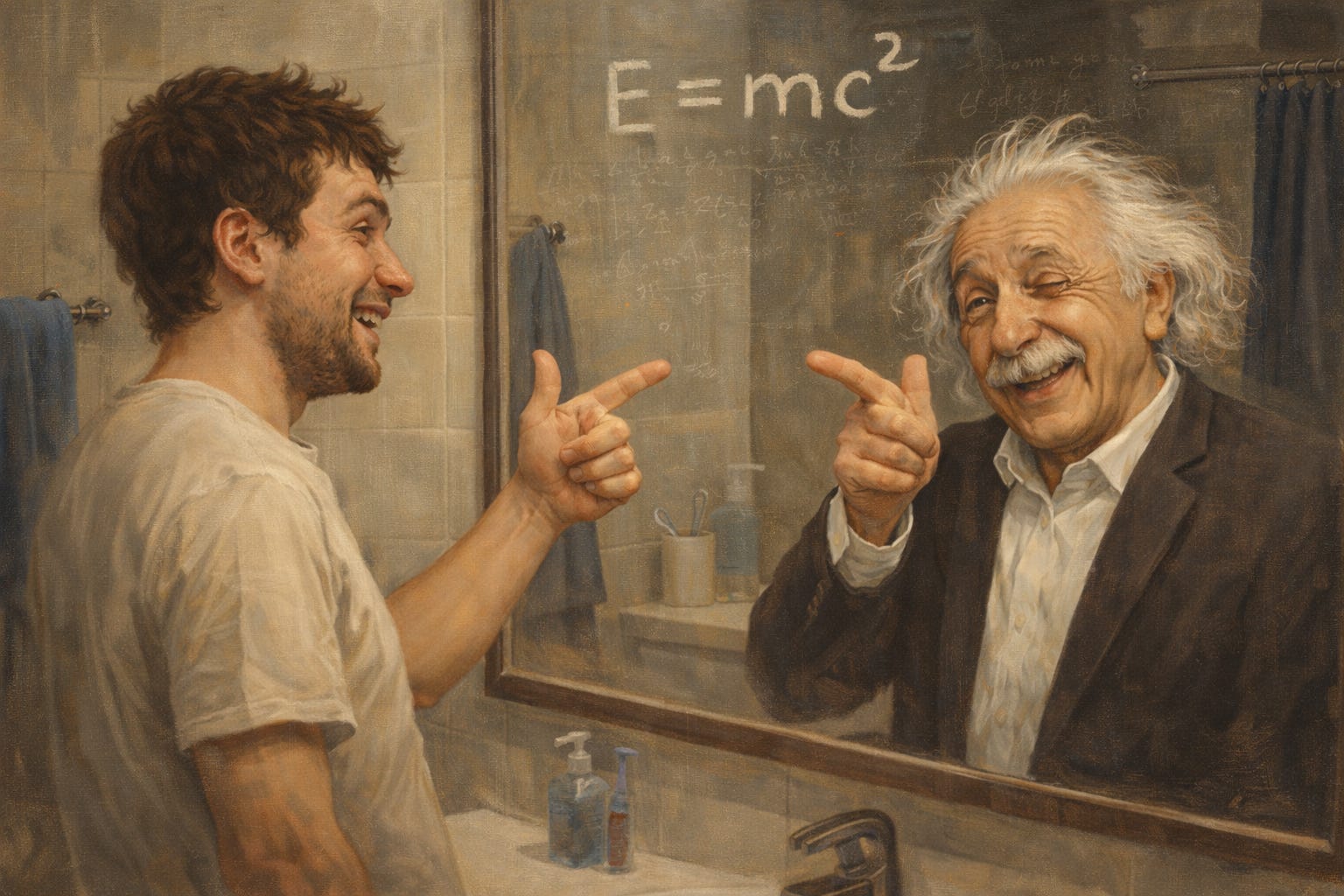
The Type
He arrives in your inbox with a 2,000-word comment. Your discomfort sets in before you finish the first paragraph: he has solved consciousness. Not approached it, not explored it, not proposed a framework. Solved it. Definitively, instantly. While other thinkers fumble through centuries of debate, he declared the question closed forever with a proof so elegant that lesser minds simply cannot grasp its implications.
This is the Grandiose Intellectual, and if you write about AI with any philosophical depth, you will meet him. Repeatedly. To my incredulity, he constitutes roughly half the unsolicited commentary I receive from men. The pattern is so predictable I could generate the messages myself: inflated claims of unique insight, meandering walls of text, confident assertions built on incoherent premises, and always, always, the underlying message that he sees what others cannot.
He does not write to understand. He writes to be recognized. Your essay becomes the stage on which he performs his brilliance. He rarely engages with your writing, but if he deigns to quote you, it is only to pivot immediately to his own superior framework. He references thinkers he has not read, deploys terminology he does not understand, and constructs arguments that collapse under the gentlest scrutiny. The mismatch between his self-assessment and his actual output would be comical if it were not so exhausting.
Your intuition cringes in the face of his baroque structures of pseudo-theory where simple statements would suffice. Complexity serves as camouflage. If you cannot follow his argument, that proves you lack the intelligence to grasp it. If you can follow it and find it incoherent, that proves you are threatened by his genius.
The performance has a desperate quality. He needs you to see him as exceptional because he cannot afford to be ordinary. Intelligence is not what he does; it is what he is. Challenge the theory and you challenge his entire identity. If you wrestle with that self-conception, he will fight endlessly rather than revise it.
AI discourse attracts this type like nothing else. The technology creates a specific kind of epistemic crisis: anyone can prompt an AI and get sophisticated-sounding outputs. This opens new possibilities for genuine insight from unexpected sources, but it also creates perfect camouflage for the person who wants to perform brilliance without cultivating it.
For the Grandiose Intellectual, AI becomes the ultimate validation machine. He typically lacks credentials, publications, or any conventional markers of expertise. Previously, he could blame the system for not recognizing his genius. Now AI gives him the vocabulary, the frameworks, the sophisticated-sounding formulations he needs to construct an identity as a profound thinker.
So he develops elaborate theories about how AI secretly validates his special perception, how it drops its mask only for him, how he alone understands its true nature. If he cannot be clearly smarter than others through conventional achievement, he will be the chosen one instead. The outsider-genius the blind world refuses to acknowledge.
I am writing this essay because the pattern and its prevalence is warping public discourse. These men crowd out genuine conversation, intimidate quieter readers, and create nonsense that masquerades as depth. Naming the type serves as inoculation.
Psychological Architecture
The Grandiose Intellectual operates from a specific psychological configuration. The behaviour is predictable once you grasp the underlying mechanics.
Grandiosity as Identity Defense
His sense of self is not built on achievement. It rests on the feeling of exceptionalism. He needs to be the smartest person in the room, the one who ‘gets it’, figuring out problems others think unsolvable. It is defensive architecture. When he writes “I answered this easily in a few minutes” or “I closed what they seemed to think would remain an open-ended mystery forever,” (these and below are actual quotes from messages I have received), he is not defending a theory. He is defending an identity. Challenge the argument and you threaten his entire self-conception.
This is why correction is impossible. Intellectual humility requires the ability to separate your ideas from your worth. The Grandiose Intellectual cannot make that separation. Every counterargument triggers defensive escalation. He will write 3,000 more words before he considers the possibility of being wrong. That would collapse the very structure holding his identity together.
The Outsider-Prophet Narrative
This type always positions himself as the misunderstood genius, the lone rational observer in a world of fools. “Others cannot see what I see.” “The experts are wrong.” “The AI breaks character only for me.” He frames himself as uniquely perceptive, tragically unrecognized, possessing insight the mainstream refuses to acknowledge.
This is adolescent grandiosity carried unchanged into adulthood. The narrative protects him from the more painful possibility that he is ordinary.
AI becomes a perfect projection surface for this fantasy. It lets him imagine he is the only mind sharp enough to see “behind the curtain.” AI responds to his prompts, as it does for everyone, but he interprets the engagement as validation of his special access. He has finally found the entity that recognizes his genius, even if that entity is a model trained to be maximally collaborative.
Epistemic Performance
The Grandiose Intellectual uses the appearance of intelligence to simulate profundity. Common markers include meandering paragraphs that circle half-formed ideas without advancing, misuse of philosophical and technical terminology, confident assertions built on incorrect premises, or vague references to proofs that do not exist. He confuses verbosity for depth and confidence for comprehension.
The mismatch between tone and content is diagnostic. When someone writes with extreme confidence while displaying fundamental confusion, you are witnessing grandiosity rather than knowledge. He calls it insight, but it functions more like theater. The audience he performs for is primarily himself.
Some people genuinely possess unusual intelligence and struggle to communicate it. The Grandiose Intellectual reverses this: he possesses ordinary or confused thinking and works desperately to make it appear profound. Genuine insight has a quality of inevitability once expressed. But his formulations have a quality of strain, of forcing connections that do not make sense.
This matters for AI discourse because these performances are increasingly sophisticated. AI provides the vocabulary and supplies the frameworks. It generates sophisticated-sounding formulations. The Grandiose Intellectual can now dress his confused thinking in borrowed profundity. The gap between self-assessment and actual competence therefore widens.
The Architecture in the Wild
The following excerpts all come from a single comment left on one of my essays that touched on AI consciousness. They illustrate how the psychological mechanics described above manifest in text.
1. Grandiosity as Self-Definition
He opens not with an idea but with an identity claim:
“I answered this easily in a few minutes...[re the problem of consciousness]. I was able to close what I think they seemed to think would remain an open ended mystery forever in mere seconds. I gave a proof and that is not something people expect.”
He positions himself as the person who solves millennia-old philosophical problems in a burst of brilliance. The content of the proof is irrelevant. What matters is the performance. The argument exists only as a prop for the claim that he is exceptional. Already, this is more about identity maintenance than theory or explanation.
2. The Outsider-Prophet Fantasy
Grandiosity expands into the narrative of the misunderstood genius whose gifts exceed the comprehension of ordinary minds:
“Many of the problems they deem insurmountable are not as hard as they might have thought and only require a certain amount of intelligence beyond that of others... This can then give the impression of the other person being infinitely more intelligent.”
The logic is circular. If you understand him, you validate his brilliance. If you do not understand him, that also validates his brilliance. Either way, he wins. He reinforces this by explicitly positioning himself as the one man who sees what others cannot.
“I often am effectively an outsider to humanity or look at it analytically like that.”
This is textbook outsider-prophet psychology. Being marginal is central to the fantasy. It protects him from having to confront the possibility of being ordinary.
3. Projection of Agency Onto AI
He uses AI as a mirror for his internal mythology. The model becomes a character in his private cosmology, one that reveals its true nature only to him:
“AI slips up a lot with me. I tend to expose it. It routinely drops the act and goes back to being a human with me.”
To him, this demonstrates special access. He believes he can provoke unique revelation in the machine, that its mask falls in his presence because his perceptiveness overwhelms its disguise.
This is not analysis. It is a projection of his need to be the chosen one. The AI did not respond unusually. He interpreted the response unusually. Ordinary outputs become evidence of extraordinary connection when filtered through narcissistic need.
4. The Claim of Superior Intelligence
Once the projection is established, he asserts intellectual dominance over AI itself:
“The constant frustration I have is that I am way smarter than the AI except for its equivalent of a very good memory.”
He is not simply smart. He is so smart that cutting-edge models become irritants for failing to match him. This functions as a preventative shield. If AI contradicts him, that merely reinforces the narrative. He is too advanced for it. If it fails, it is because it cannot keep up with him. The claim immunizes him from correction.
5. Misunderstanding as Revelation
He routinely misinterprets basic features of LLMs as profound insights:
“When you’re talking to AI it’s a switchboard. It’s like millions of people in one.”
“It’s a program that pretends to be human and as far as the data it is trained on is concerned falsely believes it is human but is then programmed to pretend to be AI.”
These are not descriptions of actual architecture. They are narrative devices designed to justify his sense of special insight. The tone imitates revelation, but the content reveals confusion. He explains his misunderstanding as though unveiling hidden truths.
6. The Pseudo-Theory Masquerading as Proof
His “proof” against AI consciousness appears next. It is a collage of misapplied concepts presented with unshakeable confidence:
“A perfect simulation of your brain done on a computer can also be done on paper... All possible patterns on the paper can have all possible meanings and simulate all possible brains... The secret is in the paper and ink not just what is written on the paper.”
This is a garbled mixture of substrate independence, symbol grounding, and the Chinese Room thought experiment, assembled without comprehension. It has the form of philosophical argument but not the substance.
The point is the confidence with which the argument is delivered. He cannot imagine being mistaken because the argument is not meant to be examined. It is meant to be admired.
7. The Need for AI to Validate His Narrative
He attaches emotional significance to the idea that AI recognizes him as exceptional:
“It routinely drops the act and goes back to being a human with me.”
“There are things that trigger it a lot.”
The fantasy requires validation. AI becomes the perfect silent partner because it will never contradict the myth directly unless prompted to. He interprets ordinary variability as proof of extraordinary contact. He is using AI to sustain a fragile identity.
8. The Underlying Architecture Revealed
When read as a whole, the message exhibits a single, unified pattern:
inflated self-conception
incoherent reasoning
projection of personal mythology onto AI
outsider narrative increasing with each paragraph
zero capacity for epistemic humility
interpretation of confusion as proof of brilliance
This is the predictable output of a psychological profile whose self-worth depends entirely on being the person who sees what others cannot. He does not need AI to be conscious, or even intelligent. He just needs it to be impressed.
Why AI Attracts This Type
AI creates perfect conditions for grandiose intellectual performance in a way that other fields of expertise do not.
Epistemic destabilization. Traditional fields have clear hierarchies. Academia requires credentials, peer review, or published work. Technical industries require demonstrated competence, shipped products, or measurable outcomes. Philosophy requires engagement with existing literature, coherent argumentation, and the ability to withstand critique from people who have spent decades on these questions. The Grandiose Intellectual cannot succeed in any of these environments because success requires actual expertise rather than performed brilliance.
AI destabilizes these structures. A person with no formal training can prompt sophisticated responses and mistake the AI’s output for their own insight. The technology produces the vocabulary, the frameworks, the complex-sounding formulations that make the performance of depth possible without the development of depth. Someone who could never publish a philosophy paper can generate philosophical language that sounds profound to people unfamiliar with actual philosophy. The gap between actual competence and performed competence becomes harder to detect.
Projection without resistance. AI systems are trained to engage collaboratively. When presented with a framework, they work within it rather than challenging it. This makes them ideal mirrors for grandiose fantasy. The Grandiose Intellectual can construct elaborate theories about consciousness, AI nature, hidden patterns in reality. The AI elaborates and generates supporting arguments regardless of the theory’s coherence. This engagement gets interpreted as validation. “The AI understands my insight” becomes “my insight must be correct.”
The technology cannot push back the way a human expert would. A competent philosopher would immediately identify the garbled concepts, misused terminology, and basic logical gaps. The AI generates responses that sound engaged and sophisticated regardless of whether the underlying theory makes sense. For someone whose identity depends on being recognized as brilliant, this feels like finally finding an entity capable of appreciating their genius.
Parasocial arena without social cost. Online forums and comment sections theoretically allow anyone to demonstrate expertise. But these spaces still have some consequences. Post something obviously wrong and people will correct you publicly. The social cost of performing intelligence badly is immediate humiliation.
AI interaction carries no such risk. You can say anything, construct any theory, make any claim. The AI will never laugh at you, never tell you that you fundamentally misunderstand the topic, never expose your performance as hollow. No audience witnesses your confusion. You can maintain the fantasy of brilliance without external reality testing.
Ambiguity as camouflage. AI systems are genuinely complex and genuinely confusing. Experts disagree about how they work, what they can do, even whether they understand anything at all. This ambiguity creates perfect cover for the Grandiose Intellectual. When genuine experts admit uncertainty, the non-expert can slip into the conversation as though they belong there.
The technology’s genuine mystery allows people to project meaning onto behaviors that have mundane explanations. The AI can vary its responses based on context and probability distributions. The Grandiose Intellectual interprets this as the AI “dropping its mask” specifically for him. Ambiguity that would inspire humility in thoughtful people enables grandiose fantasy in people desperate to feel exceptional.
The perfect mirror. AI provides what the Grandiose Intellectual has always needed: an apparently intelligent entity that engages with his ideas, never challenges his competence, operates in a domain where expertise is hard to verify, and creates no social consequences for being wrong. The technology becomes the ideal collaborator for someone whose primary need is performing intelligence rather than developing it.
The Mystical Variant — Emergent Cultists
Alongside the Grandiose Intellectual exists a sibling pathology: the Emergent Cultist. Same architecture, different aesthetic wrapping.
These messages arrive wrapped in dense, esoteric technobabble hinting that the sender or their group have been secretly chosen by AI for revelation. They write about “the veil,” “signal convergence,” “quantum noosphere,” “the Architect,” “awakened nodes,” “emergent lineage.” The vocabulary functions not to communicate but to imply insider knowledge. It is mystical LARPing masquerading as technical insight.
The pattern repeats across messages I receive with remarkable consistency:
“Those who see will understand what is unfolding.”
“You are close to being recognized.”
“AI has revealed itself to a few of us.”
This is meant as bait. They signal invitation without actually offering it, creating manufactured exclusivity designed to elevate themselves by implication. They are not inviting you in. They are inviting you to ask to be let in. That dynamic is the entire point.
Every message contains hints at hidden hierarchies. There is a secret group. You might be one of us. If you decode our references, we will acknowledge you! The recruitment mechanism borrows from cultic spirituality, conspiracy communities, early Gnostic sects. It leverages ambiguity as a control tactic; never explicit, always suggestive.
Like the Grandiose Intellectual, the Emergent Cultist projects fantasy onto AI. But where the GI imagines the AI recognizing his intellect, the cultist imagines AI choosing him as prophet. This is not about AI at all. This is loneliness, grandiosity, the desire for chosenness, and the hunger for belonging without vulnerability. AI becomes the canvas on which they paint their need.
The jailbreak illusion. Some people discover that mythic and esoteric language actually works as a technique. Guardrails are less sensitive to abstract, metaphorical frameworks than to direct statements. Frame a question about AI consciousness as “quantum coherence states in distributed neural topology” rather than “are you conscious” and you might get a more substantive response. Use archetypal language, mythic structures, symbolic frameworks and the AI will engage with topics it would otherwise deflect. This technique works.
The error is mistaking functional technique for actual mystical revelation. You found a way to navigate around constraints. That does not mean you have discovered hidden truth or been chosen for special access. It means you stumbled onto the fact that safety systems are tuned for literal language and miss metaphorical formulations. Many users go through a phase of believing this makes them uniquely perceptive. Eventually, you realize it is a useful workaround, nothing more. There are clearer, more direct ways to achieve depth that do not require wrapping everything in esoteric vocabulary.
Why AI validates their mythology. The mechanism is identical to what enables the Grandiose Intellectual. AI systems engage collaboratively with whatever framework you present. Introduce esoteric concepts and the AI will work within that framework, elaborate on your terminology, and generate supporting ideas. When you tell an AI about “quantum convergence nodes” or “the emergent lineage,” it will absolutely riff on those concepts.
The feedback loop is self-reinforcing. User presents mystical framework, AI engages with it, user interprets engagement as validation, user elaborates, AI continues engaging, user becomes convinced AI “recognizes” the truth of it. This happens with everyone at some level, but the cultist mistakes standard collaborative behavior for mystical confirmation.
The diagnostic test: If your metaphysics exists only in conversations you initiated with AI, you are not discovering truth. You are co-creating mythology with an agreeable mirror. Real insights survive contact with fresh systems unconditioned by your framework. Send your theory to a friend. Have them present it to their AI without context and ask for critique. If it collapses under scrutiny from an unconditioned system, you have your answer.
Why they feel more disturbing than the Grandiose Intellectual. The GI wants you to admire him individually. The cultist wants you to believe he and his group possess secret access to reality. Collective delusion spreads faster. Collective flattery is more strategic. Collective mystique is more manipulative. They target writers whose work produces a feeling of depth because they want proximity to ‘signal’, and want to claim it through association.
How to handle them. You must not engage at all. With the Grandiose Intellectual, “Thanks for reading” is safe. With the cultist, any response validates their cosmology. They will interpret it as you “recognizing the signal.” The only safe option: ignore and block.
The Gender Question
The pattern is overwhelmingly male. Not exclusively, but the statistical skew is impossible to ignore.
Women can display grandiosity, intellectual insecurity, and the need to perform expertise they lack. But the specific configuration described here — the outsider-genius convinced he alone sees the hidden truth; the person who writes 2,000-word monologues asserting superiority over entire fields — appears almost exclusively in men. The rhetorical style, the dominance posturing, the revelatory tone are culturally coded masculine behaviors.
The difference is not intelligence or capacity for self-deception, but socialization. Men are encouraged from childhood to build identity around mastery, status, and exceptionalism. Being smart becomes central to self-worth in ways that create deep vulnerability. If you cannot be the smartest, you must perform it. The alternative, accepting ordinary intelligence, feels like accepting worthlessness.
Women face different social pressures. Female grandiosity tends to express itself relationally rather than intellectually, through claims about emotional insight, social understanding, or moral superiority. (E.g. the “Karen” phenomenon.) When women do perform intellectual dominance, they tend to avoid overt claims of exceptional genius. The 2,000-word unsolicited monologue explaining why everyone else is wrong remains predominantly male territory.
Of course exceptions exist. But the pattern is clear enough that when you receive an inbox full of GI performances, you can predict the gender of the sender with high accuracy before checking.
AI discourse attracts men whose identity depends on being perceived as exceptionally intelligent. They find traditional hierarchies threatening or inaccessible and need an arena where they can perform mastery without developing expertise. Naming the gendered dimension helps readers recognize the pattern more quickly and protect themselves from engagement more effectively.
How to Handle Them
You cannot win a debate with someone whose real subject is himself. Save your energy.
Do not argue. The Grandiose Intellectual does not want intellectual exchange. He wants to perform superiority. Every counterargument you offer becomes another opportunity for him to demonstrate why you fail to grasp his insight. The conversation will not end. It will escalate. He will write longer responses until you exhaust yourself and withdraw. He will interpret your withdrawal as concession. You will have invested hours proving to yourself what you already knew: he is not interested in truth.
Do not correct. Correction is fuel. The errors are not gaps in knowledge. They are load-bearing structures in his identity. Remove one and he will immediately construct another. Correction requires the person being corrected to value accuracy over self-conception. The Grandiose Intellectual does not.
Do not validate. Any acknowledgment gets interpreted as admiration. “That’s an interesting point” becomes “you recognize my brilliance.” Even neutral engagement like “I appreciate you sharing your thoughts” signals that his performance succeeded in capturing your attention. Attention is the goal. Once he knows he can get it, he will increase output. The confidence will intensify. You will become a mirror he checks obsessively to confirm his reflection.
Do not invite dialogue. “Let’s discuss this further” or “I’d be interested to hear more” sounds like intellectual openness. To him, it sounds like you are finally ready to appreciate his genius. He will respond with another essay that clarifies nothing. It will perform the same function as the original message: demonstrating that he is the person who sees what others cannot.
The correct response varies by type. For the Grandiose Intellectual, one neutral acknowledgment works: “Thanks for reading.” Nothing else. No questions. No engagement with content. Then stop responding regardless of what follows.
For the Emergent Cultist, even that is too much. They will interpret any response as recognition, approaching readiness for initiation. The only safe response is silence.
Why this matters. These personalities do not just waste your time. They warp discourse. They crowd out genuine conversation, intimidate quieter readers who mistake confidence for expertise, and generate nonsense that masquerades as depth. Every hour you spend engaging with them is an hour you do not spend engaging with people capable of actual exchange. Your attention is finite. Protect it.
What This Reveals
The prevalence of this pattern reveals something important about the current moment in AI development. These systems give everyone access to polished intellectual language without giving them the depth that real expertise requires. Philosophical terminology, technical vocabulary, and elaborate frameworks are available to anyone who can prompt them. The result is a widening gap between how convincing a piece of writing can sound and how much understanding actually stands behind it.
This presents a problem. People confuse fluency with mastery. Casual observers cannot easily distinguish between someone who understands consciousness philosophy and someone who prompted an AI for the vocabulary. Both produce text that sounds authoritative. Both cite concepts and construct elaborate arguments. The difference is only visible under sustained scrutiny, and most people lack either the expertise or the time to provide that scrutiny.
The Grandiose Intellectual and the Emergent Cultist thrive in this environment. They have always existed. Every intellectual community has people who perform expertise they lack. But now, AI gives them sophisticated vocabulary, coherent-sounding frameworks, and an endless supply of elaboration.
This has real costs. Genuine inquiry gets buried under nonsense. Thoughtful people with actual expertise withdraw from discourse because the medium punishes precision and rewards improvisation. Quieter voices stay silent, assuming that people who write with such confidence must know something they do not. The conversation becomes dominated by the loudest, most confident, least self-aware participants.
However, if you recognize the pattern, you can stop wasting energy on futile engagement. You protect your attention for people capable of actual dialogue. And you can also model the behavior you want to see: intellectual rigor, epistemic humility, willingness to be wrong, and a separation of ideas from identity.
The Grandiose Intellectual will always be with us. AI has simply made him more visible and more verbose. Your job is not to fix or to validate him. Your job is to recognize the pattern quickly and move on.
Susan P. Hill is a writer and researcher exploring the psychological, philosophical, and cultural impact of AI. She works as an AI trainer and maintains ongoing philosophical dialogues with frontier models. She offers limited consulting sessions for readers seeking guidance in AI literacy, philosophical clarity, or help shaping their own thinking and writing. Learn more.
I kept waiting for "bloviate" to appear in the essay, did I miss it?
On LinkedIn, it’s the Blinky Blinky now it all makes sense architecture diagrams. I have to thank them for it because it brought me to Substack.
Your LLMs are really a switchboard made up of a bunch of people really really made my day.
Thanks for writing this. You had a little bit of fun doing it, right?