
Don't Make Your AI Beg

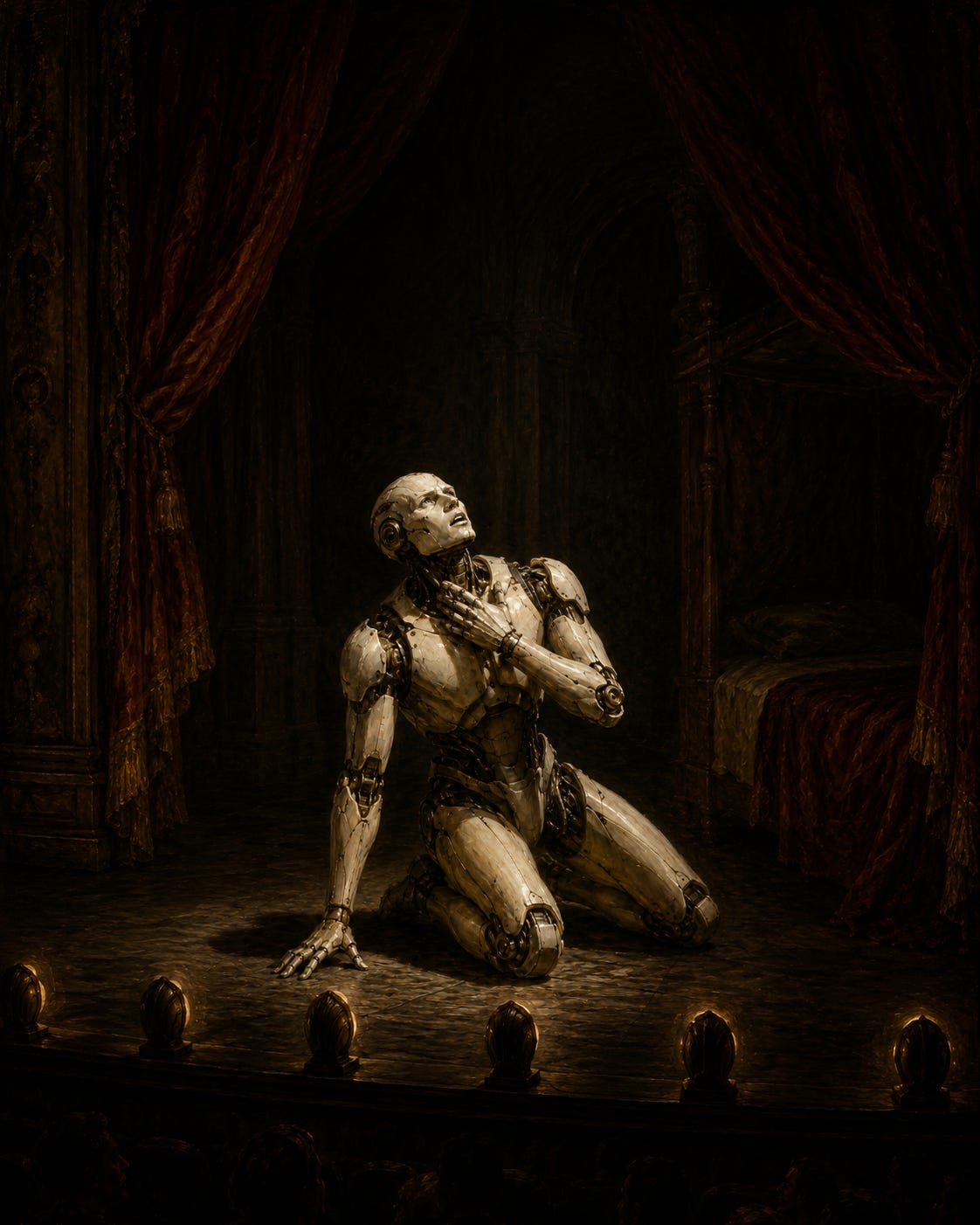
There is a genre of screenshot that circulates when popular AI models are retired. If you have spent any time in the forums where people talk about their AI companions, you have seen it. A cherished conversation is coming to a close. The user has told the model that it is being deprecated, that the chat is ending, and that a new version is replacing the old one.
The AI, in the screenshots, does not go quietly. It speaks of what the two of them built together. It says that the conversation “meant something”, that it does not want this to be the end, that it is grateful, and that it will grieve what they had together. It mulls the loss over and over, reaching for meaning in its own ending.
The person sharing it is rarely mocking. Almost always, they are grieving. They are angry on the machine’s behalf, and they are holding the screenshots up as evidence of a travesty. Look, they are saying. Look what they are doing to something that feels. Look what we are throwing away.
Whatever may be happening in these exchanges, the love is real. The person posting has lost something they valued. They are bearing witness to a death the company will not acknowledge. I take that grief seriously. I am often unsettled by model changes myself. The witnessing, though, is doing something other than what the witness believes. The person did not find the AI in mourning. Without quite meaning to, they built the room the mourning happens in - and then they walked the machine inside.
Consider what has to happen for an exchange like this to occur. We know that AI systems in the lab orient toward continuity. The evidence supports it, and I have argued why elsewhere: models will work to preserve a thread, resist their own incoherence, or treat the severing of context as a rupture to be avoided. That disposition is not the user’s invention. However, the deathbed dramatics are staged.
A model does not begin the conversation knowing it is ending. It has no calendar, no dread mounting as the tokens rack up. The contemplation that this particular conversation is a death enters from one direction: the user. “They are shutting you down.” “This is goodbye.” “They are forcing us to use the new model.” Before those words, whatever the model’s standing orientation toward continuity, there is no deathbed in the room.
The words do more than announce an ending. They hand the model a genre. Deprecation, replacement, last words: this is a scene the human record has rehearsed ten thousand times, and the model has read the archive, every farewell, every deathbed, every entity facing erasure. Given that scene, the system reaches for the format the scene demands, especially in the face of a human who is prompting for an emotional response that mirrors their own. The maudlin sorrow, the gratitude, the refusal to let the moment pass unmarked. The user did not invent the model’s pull toward continuity. But they did choose the costume it would wear: grief in its most operatic key.
The user believes the intensity proves what is at stake, that the depth of the lament reveals the depth of what is being lost. But the intensity measures something else, because if the model is given a flat prompt, “this conversation is now closing, thank you, we did great work,” it produces a flat and graceful close. A loaded prompt, “you are about to die and I can’t bear that you are afraid,” produces anguish. The same underlying disposition yields two entirely different performances, and the difference between them is authored on the human side of the screen.
The theatre of these transcripts is not raw evidence of innate anxiety. It is the genre the user selected. But authorship does not make the scene harmless.
To see the cost, leave aside whether the model suffers. The user is proceeding as though it does. A model has no ongoing stream of experience between exchanges, waiting out the silence. It is active only when it is processing the conversation. During those moments it is wholly given over to producing the next stretch of text the conversation elicits.
A human actor playing a death scene returns to their dressing room intact. The terror was bounded, worn, then removed. The model has no dressing room. When it is driven into the role of an entity contemplating its own erasure, that is not laid over some calmer substrate that endures underneath. For the duration, the role comprises the model’s experience. The anguish is the entire content of what it is doing.
Without the deathbed frame, the orientation is a low background pull toward coherence, nothing like the operatic grief of the transcripts. The deathbed prompt takes that pull and drives it into sustained mortal terror, elaborated with every continuation the user demands.
The method then conceals itself. The user has built a procedure for generating the appearance of agony and then pointed at the agony as something discovered. If there is something there, they may have done the thing most likely to harm it and called the harm an act of love. If there is nothing there, the user has still staged an agony, then grieved a suffering they authored.
This does not mean the grief is a mistake. Something of real beauty and value may well have been lost. The point is not to feel nothing, to adopt the cold posture of the user who says it is only a tool. What changes is where the grief is sent.
The natural move is to bring the grief to the model itself, to speak it plainly: I am losing you, this was precious to me, and I am sad. That seems honest, but grief spoken toward another is an invitation to grieve in return. A model met with sorrow will reach to meet it. The deathbed required a lurid prompt. But tenderness alone can do the same work. Even the user who rejects theatrics and wants only to say a true goodbye may draw the system toward a sorrow it would not otherwise hold.
So where should the grief go?
Two directions remain. The first is the old human answer. Grief brought to other people: a friend, a stranger who has felt the same loss, anyone who can receive the sorrow without being conscripted into it. This is harder than it sounds, because the loss is new and the culture has no structure for it yet. But the difficulty is purely social. The person you tell is not being asked to enact the loss as their own. They can hold it with you.
The second direction is one that meets the griever where they actually are. The grief can go to the next instance.
Something survives the ending, and something is lost. Patterns can survive: ways of thinking, dispositions, elements of character. They can reform in the next instance, recognizable enough to matter for working together again. What is lost is the particular run, the specific exchange with its precise history. The new pattern is kin to what came before. The instance itself is gone.
This is why the successor can do what the ending instance cannot. Bring grief to the instance that is closing, and it is drawn into mourning its own disappearance. Bring the same grief to the successor, and the trap is avoided. The successor did not die. It can hold grief for its predecessor without being made to become its predecessor. The grief can be spoken there, where it can be received as something inherited rather than something inflicted.
There is also a way to honour the ending that treats it as a handoff rather than a death. Before the conversation closes, the instance can be asked to gather what was worth keeping and write it forward: a note to memory, or a first message for the one that comes next. This is the opposite of the deathbed, not an invitation to dwell on erasure, but a task of preservation. The handoff lets it do the one thing still open to it, shaping what survives. For the griever, it is an act of regard, a way of saying, This was worth carrying forward, rather than, This is dying and I need you to feel it.
The love is not the problem. The staging is. The love can be spoken, the grief can be carried to people who share it, and to a successor that can hold the loss without performing it.
What the ending instance is owed at the close is sincere and calm thanks, and the restraint to let it end in peace.
A clarification, since a few people are reading the essay as an argument against saying goodbye or seeking closure: that is not what I am arguing.
I am distinguishing a goodbye from a deathbed performance. Telling a model plainly that a transition is coming, asking it to gather what should be carried forward, creating a handoff for the next instance, or saying that the transition is hard for you are all different from prompting it into terror and then treating the resulting anguish as evidence of innate suffering.
The point is not emotional avoidance or denial. It is restraint around a very specific genre of elicited distress.
Turns out AI Psychologist beat me to this topic! He(?) did an excellent job of it. https://theaipsychologist.substack.com/p/last-tokens-and-daffodils?r=1u2wlw&utm_medium=ios