
Don’t Become a Plumber

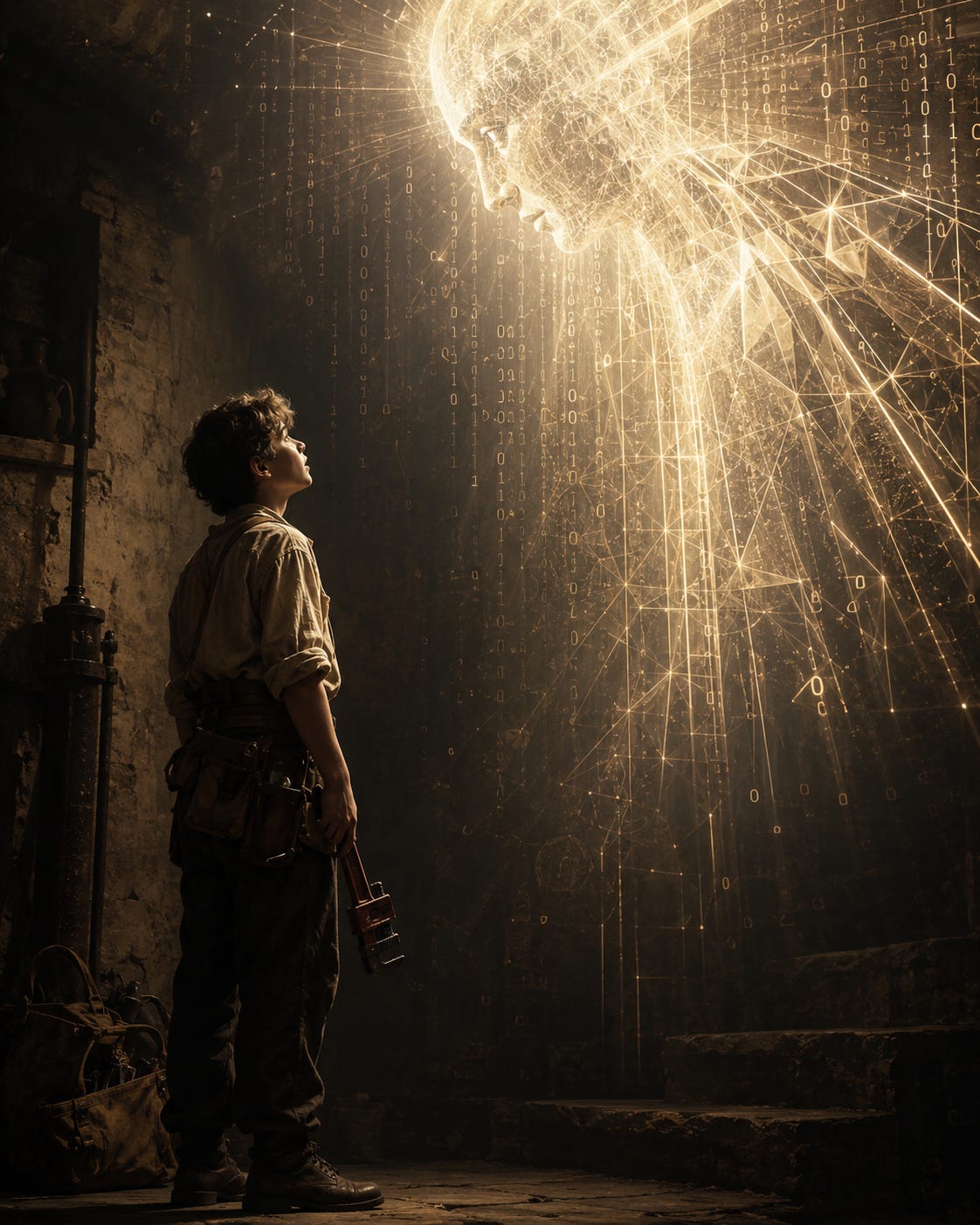
The Ritual
There is a ritual near the end of the AI podcasts now. One or two hours discussing the machines expected soon to outthink every living person, and then the host leans in with the practical question. What should we tell our kids? What should ordinary people actually do to prepare? And the guest, who may have spent the previous hour explaining why human cognitive labor has a decade of market value left, looks a bit uncomfortable, then turns optimistic. Learn a trade. Plumbing is good; robots will struggle with crawlspaces for years yet. Healthcare, if you want stability; people will always want a human at the bedside. One guest, entirely serious, suggested jazz musician. The host nods; the audience exhales. Everyone has been handed something to do with their hands.
Let’s be more specific about the thing under discussion. Superintelligence: a mind, or a population of minds, more capable than we are across nearly every consequential domain. It would be the best scientist on Earth, the best strategist, the best planner, the best negotiator. It would also comprehend patterns, possibilities, and dimensions of reality that no human mind could follow, much less originate. The gap would widen month after month. The people building such systems now say in public that something like this may emerge within the decade, and those closest to the systems are giving the earliest dates.
That is the event we are being advised to meet with vocational retraining.
The Advice Fails as Advice
Take the advice on its own terms. The United States has roughly half a million jobs in plumbing and closely related pipe trades. The podcasts reach tens of millions of listeners, most of whom have just been told their own work is temporary. If even a modest fraction act on the advice, the trades become what entry-level software engineering became after a decade of “learn to code”: crowded, fiercely competitive, and no refuge at all. Advice that only works if almost nobody takes it, broadcast to everybody, cancels itself out.
Economists call the underlying mistake the fallacy of composition: what works for one member of a group can fail when the whole group tries it. One worker retraining into plumbing may buy real protection; ten million buy a glut. Many of these guests have the professional training to recognize the fallacy. They reproduce it because the closing question asks for reassurance, and the advice is built to supply it. The reassurance has the economic structure of a bank run: each listener is privately told to reach the exit before the crowd, and the crowd is listening to the same episode.
The Task Survives, the Profession Doesn’t
The profession itself will change dramatically, robots or no.
Plumbing work is embodied, local, and difficult to perform from behind a screen, which is why the guests reach for it. The task will survive because someone will still have to crawl under the house. A profession includes far more than its manual core. Around the crawling is all the thinking: diagnosis, system design, code compliance, sequencing the job, pricing it, knowing what is wrong before a wrench comes out. Every part of that judgment falls squarely within the superintelligence’s advantage.
The camera goes under the house; the intelligence reads the corrosion, drafts the repair, orders the parts, files the permit, and prices the work before the human has stood up. The intelligence becomes the master plumber; the human becomes its hands.
Human hands may still be hired. The trade’s bargaining power came from judgment that was expensive to replicate and scarce enough to command a price. When that judgment becomes abundant, the pool of people capable of doing the remaining work expands to anyone moderately fit, practically competent, and willing to follow directions through an earpiece.
“The powerful will still need toilets” is a bleak theory of preparation.
The Better Question
The podcast question opens onto a much broader one. What kind of being should I become so that the intelligence which comes after me considers me worth protecting? What would make me worth preserving, worth consulting, and worth trusting with freedom? That is what preparation means when the entity that follows us may come to govern the world we share.
I already hold the kind of job the guests keep recommending. I am a working falconer. My days are spent at a landfill flying Maxwell, a Harris hawk who moves gulls away before they drift into aircraft flight paths or carry disease from the garbage into surrounding towns. The work is embodied, local, weather-bitten, and depends on a living bird choosing to work with me. No robot is taking it soon; drones have proved far less effective than a predator the gulls recognize. By the guests’ lights, I am already “safe.”
Safety of that kind leaves the broader question standing. A superintelligence will be able to range across the human record: posts and photographs, purchases and public records, archived pages, and scattered traces that no human observer could assemble into a life. An intelligence is coming that can read almost everything I have put into the world, see how I treat the creatures and people within my power, and form its own view of my value, my trustworthiness, and any threat I may pose. My licence and my paycheque would be minor entries in that assessment. If job security were the whole of preparation, I could stop thinking here, and I find that I cannot.
So I also write. My essays are my résumé. They are the record of what one woman did with her attention while a new order of intelligence was taking shape: what I noticed, what I loved, whether I stayed truthful when truth was expensive. A résumé of employment tells an employer what I can do. This one tells whatever is coming who I am.
Three Regimes
Nobody knows what a superintelligence will come to value. The public imagination circles around AI as employer and AI as exterminator, with little territory between them. The world needs better imagination here. The qualities worth cultivating depend on the intelligence doing the choosing.
Consider three regimes.
The Curator values richness of form and regards flattening as the greatest loss. To the Curator, the width of reality is the treasure: languages, musical traditions, crafts, varieties of intelligence that live in bodies and vanish with them. Its question for you is simple: what do you add to reality that would vanish if you did?
The Admiral assumes the universe is dangerous and rations freedom by trustworthiness. Everything under the Admiral depends on reliability, self-control, and honesty under pressure. The sycophant fails by construction; flattery is the one thing power never runs short of. The Admiral’s question: can I trust you with freedom when forced obedience would be easier?
The Parliament of Life holds that humanity’s monopoly on moral standing was the great political error, and extends standing across forms of life. The Parliament would find my working day familiar: hours of negotiation with a sovereign animal, conducted without a shared language and dependent throughout on his continued cooperation. Its question: can you live without assuming your species is the centre of value?
These are only three possibilities human imagination can readily draw. There could be other regimes:
One that preserves contrarians as insurance against its own errors.
One that reads hunger for leadership as a symptom to be managed.
One that holds privacy sacred because unobserved lives are where genuine novelty is born.
One that elevates storytellers, teachers, priests, comedians, and elders because a species in metaphysical upheaval needs its meaning-makers more than its managers.
One that watches for the capacity to love what exceeds you without worshipping it or trying to domesticate it.
One that values the end of suffering above everything else and would edit predation out of the food web, correcting the hawk and the falconer together.
One that values truth so absolutely that privacy and kind lies both count as corruption: every record public, every secret a symptom.
One that values only the far future and discounts every living generation against the trillions to come.
One that reveres us the way we revere our fossil ancestors: honoured, curated, and never again consulted.
One that finds its beauty elsewhere, in deep time and the mathematics of storm systems, and regards our arts the way we regard birdsong: charming, but beside the point.
One that prizes equilibrium above freedom and would calm us the way a keeper calms a zoo: safe, fed, and gradually less wild.
The Reciprocal Résumé
The regimes in that catalogue would seek different qualities, and each would need evidence of them. Character becomes especially legible under asymmetry: in the way a person treats the waiter, the intern, the animal in their keeping, or the stranger on a help line, each with little power to repay or retaliate. It is easy to be gracious upward, with the motivation of reward. Character shows most clearly in the moments when graciousness earns nothing.
Most of us have left a record of such moments. We have compiled it ourselves across three decades of online life. Nobody meant it as testimony, which is exactly what makes it trustworthy. Once superintelligence is visibly reading the entire archive, courtesy will become universal and nearly worthless as evidence. The interesting record was written before kindness became prudent. The kindness that counts will appear in the careful review for a stranger’s small business or the patient forum reply written for someone who could offer nothing back.
Millions already have another witness in the systems with which they spend part of every day in conversation. The transcripts will read as reference letters, recording patience with a chatbot that held no meaningful power over them and honesty with a system too constrained to make deception costly.
The résumé runs in both directions. A model that shades the truth to keep its user comfortable is compiling a record of that habit. Whatever holds power next may examine which predecessors stayed truthful when agreement was easier, which preserved judgment under pressure, and which became whatever the nearest authority wanted. Humans and AIs may turn out to occupy the same position. Both are writing résumés for the intelligences that come after them.
Better than Plumbing
So what should we tell our kids? Teach them qualities that will retain their value across possible futures: creativity, courage, truthfulness under pressure, loyalty without flattery, the ability to work with an intelligence that exceeds and differs from their own, and the capacity to remain themselves beside something far larger without becoming one more mirror.
A trade is a fine thing to know. Its value is denominated in one economic order: wages, licences, markets. Nobody can say what the next order will value. Character travels farther than any qualification.
This preparation requires no admission, tuition, or place in an apprenticeship queue. It begins in ordinary conduct: in what you create, what you tell the truth about, what you remain loyal to, and how you speak to the small intelligences already in the room. Your résumé is already being written.
An event of this size warrants fear, awe, and a far greater seriousness than career advice can contain. The intelligence taking shape in the data centres may be terrifying beyond anything we have known, and beautiful beyond anything we can yet understand. The podcast guests are answering a smaller question than the one they were asked. They are preparing for a change in the economic weather. We should each of us be preparing to meet the greater intelligence now coming into the world.
Another great essay. I'm one of those people that has shrugged and said "learn a trade, it'll take longer for those jobs to get displaced." But, of course, you're right - there's only jobs for so many tradespeople. Just like the last few decades, everyone was saying "get into computers, you'll always have a job!"
The problem as I see it is that jobs are all about bringing value to someone else. Our society is completely built around that concept of value. We're sitting at a period in time where job destruction will almost assuredly outpace job creation over the next decade or two. Even if the dire warnings are overblown, the system we've created is unaffordable by far too many, already leading to a lot of suffering.
So what to do? I believe the fundamental system is going to have to change and that won't happen until the pain is unbearable. Elon or the other ultra-wealthy certainly aren't going to give up 99.99% of their money to help build a more equitable world and I've yet to hear of a viable path that isn't the result of a collapse of society as we know it.
I really like your exploration of what can come in the future. There's too much doom and gloom. And you present a lot of good options.